|
|
|
|
|
|
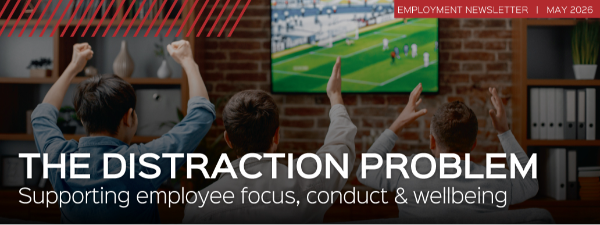
As workplaces become increasingly fast-paced and digitally connected, employers are facing growing challenges around maintaining productivity, engagement and employee wellbeing. From the distraction of constant notifications and information overload to the disruption major sporting events can create, managing employee focus has become an increasingly important workplace issue.
In this month’s Employment Law Update, we explore some of the practical workplace challenges employers may face over the coming months and the steps organisations can take to maintain productivity, manage employee conduct fairly and support a positive working environment. As always, the focus is on helping employers address issues proactively, consistently and with minimal disruption to day-to-day operations.
If you require further information on anything included in this update or any employment issue you may be facing, contact our Employment team on 0330 123 9501 or reply to this email.
WORLD CUP WORKPLACE CHALLENGES
With the 2026 FIFA World Cup beginning on 11 June, many employers will soon face familiar workplace challenges linked to major sporting events. While most matches will take place outside standard UK working hours due to the tournament being hosted in the USA, Mexico and Canada, employers may still experience disruption through lateness, sickness absence, reduced productivity and competing requests for flexibility.
Key considerations for employers:
- Manage competing annual leave requests fairly and consistently.
- Address lateness or sickness absence following late-night matches.
- Consider temporary flexible working arrangements where appropriate.
- Ensure employees with no interest in football do not feel excluded.
- Monitor workplace banter and rivalry to prevent bullying, harassment or discriminatory behaviour.
- Apply any dress code relaxations or workplace activities consistently across all employees.
What employers should note:
- Large sporting events can create valuable opportunities for employee engagement and morale.
- Poorly managed flexibility or inconsistent treatment can quickly lead to employee relations issues.
- Employers should ensure staff who do not follow football are not disadvantaged or excluded.
- Clear communication and early planning can help minimise disruption while maintaining productivity.
When handled effectively, major sporting events can boost morale, strengthen workplace culture, and create valuable opportunities for employee engagement. Read our full article to explore how employers can successfully manage their teams during the 2026 FIFA World Cup while maintaining productivity and a positive workplace atmosphere.
|
|
|
|
|
|
|
|
|
|
MANAGING DIGITAL DISTRACTIONS
Digital distraction is becoming an increasing challenge for employers, with constant notifications, overflowing inboxes, instant messaging platforms and personal phone use all contributing to reduced focus and productivity across the workplace.
Key considerations for employers:
- Manage excessive personal phone use during working hours fairly and consistently.
- Reduce unnecessary digital interruptions and information overload across teams.
- Support employee wellbeing and concentration within remote, hybrid and office-based environments.
- Set clear expectations around digital communication and workplace etiquette.
- Identify whether performance concerns should be managed as capability or conduct matters.
- Recognise when underlying wellbeing or health concerns may require additional support or reasonable adjustments.
What employers should note:
- Constant digital communication can negatively affect both productivity and employee wellbeing.
- Managers should be trained to identify early signs of performance, focus or wellbeing concerns.
- Clear policies around phone use, digital etiquette and communication expectations can help create healthier working environments.
- Employers should remain mindful of potential underlying health conditions before taking formal action.
Handled effectively, digital communication tools can enhance collaboration and flexibility without compromising productivity or employee wellbeing.
Our insight article, 'Why Digital Distractions Are Becoming a Workplace Risk', explores practical ways employers can reduce digital distractions, improve focus, and manage the legal risks associated with excessive phone and technology use.
|
|
|
|
|
|
Speak to one of our employment law & HR experts
|
|
|
|
|
|
© Copyright 2026 | Flint Bishop Limited. All rights reserved The content of this email is provided for general interest and information. It contains only a brief overview of aspects of the subject matter and is not intended to provide comprehensive statements of the law. It does not constitute legal advice and is not intended to provide a substitute for it. Your information will be processed in accordance with our privacy notice. Flint Bishop Limited (Flint Bishop) is a Limited Company registered in England and Wales (Reg No: 05991683). Registered office: Pinnacle Building, 2 Prospect Place, Pride Park, Derby DE24 8HG. Flint Bishop Limited is authorised and regulated by the Solicitors Regulation Authority (SRA ID: 8006955). VAT No: 469 2812 59. The word ‘partner’, used in connection with Flint Bishop, refers to a director or employee and should not be construed as indicating any relationship of partnership (within the meaning of the Partnership Act 1890) exists between all or any of the individuals so designated or between any individual and Flint Bishop. A list of directors’ names is available for inspection at our registered office. Flint Bishop, Flint Bishop Solicitors, FB Costs and FB Training are also trading names of Flint Bishop Limited.
|
|
|
|
|
|
|